



Modular Socket Outlet Types: How to Choose the Right One for Your Home
October 30, 2026Miniature Circuit Breakers vs Circuit Breakers: Pros & Usage Scenarios
Electrical circuit protection is an important aspect of any electrical system. It protects houses and commercial spaces when short circuits or overloads occur. These events can cause circuit wiring to overheat, leading to damaged electronics and, more seriously, fires. That is why every residential and commercial building uses automatic disconnect devices in its distribution panel.
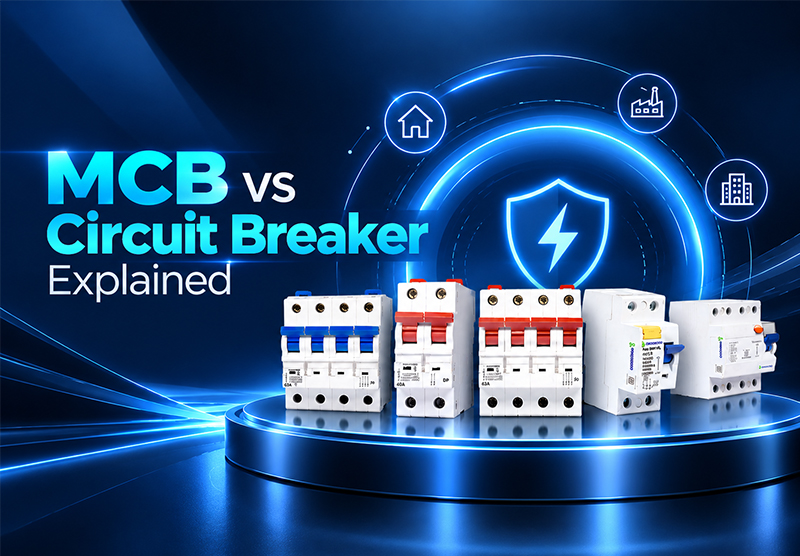
The terms MCB (miniature circuit breaker) and circuit breaker are often confused with one another. Although similar, these devices have different ratings and applications for use. Most people are not familiar with them and, therefore, it is challenging to make a comparison between an MCB and a circuit breaker.
This guide will help you understand what a miniature circuit breaker (MCB) is and the difference between an MCB and a circuit breaker.
What Is a Miniature Circuit Breaker (MCB)?
A miniature circuit breaker (MCB) is a small electrical safety device used in a circuit to provide overload and short-circuit protection. It mounts on a standard 35 mm DIN rail within a consumer unit or distribution board. The device interrupts the power supply in circuits that have faults. MCBs generally have a low amperage rating, typically 0.5 A to 125 A.
An MCB provides protection to the wiring and equipment in the circuits in two ways. Firstly, it offers overload protection, which works by using a bimetallic strip. The strip bends when excessive current flows through the circuit, thus moving the latch to open the circuit. Secondly, it also provides short-circuit protection. It uses a solenoid that is energised by a large current surge.
The solenoid’s magnetic pull drives and opens the circuit breaker mechanism in a fraction of a second. Unlike fuses, MCBs are manually reset and interrupt the circuit, restoring the power supply as soon as the fault has been dealt with.
Difference Between MCB and Circuit Breaker
A circuit breaker is a general term that covers a wide range of circuit interrupters, including miniature circuit breakers (MCBs). Therefore, in the MCB vs circuit breaker comparison, a circuit breaker will also include an MCB.
The main difference between a circuit breaker and an MCB is that an MCB refers to a small-sized and specific type of circuit breaker that mainly offers overload and short-circuit protection for lower-current and low-voltage applications.
When people compare miniature circuit breakers vs circuit breakers, they are contrasting a particular breaker (MCB) with other circuit breakers, including the Molded Case Circuit Breakers (MCCBs) and Air Circuit Breakers (ACBs).
| Feature | Miniature Circuit Breaker (MCB) | Molded Case Circuit Breaker (MCCB) | Air Circuit Breaker (ACB) |
|---|---|---|---|
| Design | Compact, DIN-rail mounted | Bigger, panel or switchboard-mounted | Heavy industrial frame |
| Current rating | 0.5 A to 125 A | 15 A to 2,500 A | 400 A to 6,300 A |
| Breaking capacity | 4.5 kA to 10 kA | 25 kA to 200 kA+ | Extremely high |
| Trip mechanism | Fixed thermal-magnetic | Adjustable thermal, magnetic, or electronic | Advanced electronic or LSI |
| Primary placement | Homes, branch circuits, light commercial | Industrial feeders, heavy machinery, commercial mains | Main low-voltage service incomers |
Comparatively speaking, MCBs protect smaller branch circuits, whereas larger circuit breakers protect larger loads, feeders, and industrial systems.
MCB vs. Circuit Breaker for Home
For domestic applications, the MCB vs circuit breaker for home comparison is usually between an MCB and larger breakers like MCCB and ACB.
For residences, MCBs are the best circuit breakers for home or home distribution boards because they are modular, cost-effective, easy to reset, and ideal for protecting domestic low-voltage circuits.
Therefore, MCBs are mainly used for protecting individual branch circuits or sub-panels. They are also applied to provide overcurrent protection for small power appliances and lighting networks within the 125 A rating. An MCB is a small circuit breaker; therefore, it is not the most appropriate circuit breaker for a home main incomer or industrial feeders.
To determine which MCB is suitable for a home circuit, it is essential to consider the circuits’ load and respective wire sizes. Generally, 6 A to 10 A circuit breakers are used for lighting circuits, and 16 A to 25 A circuit breakers are used for general power outlets. The size of a circuit breaker will depend on the design of a circuit.
What Are the Different Types of MCB? Poles and Trip Curves
As mentioned above, the main types of MCB are mainly determined by the number of poles and trip curves.
Pole Configurations
The number of poles determines the number of conductors a circuit breaker can protect or switch. A single-pole MCB is used to control and protect a single live phase conductor. The single-pole MCBs are usually applied to residential lighting and general power distribution circuits that have a 230 V rating.
A double or two-pole MCB is mostly available in a double-pole circuit breaker configuration for either single-phase or three-phase applications. This type of circuit breaker is used to disconnect both the line, i.e., the live phase, and neutral conductors.
A double-pole circuit breaker isolates both current-carrying conductors simultaneously, i.e., in a single-phase circuit, making it ideal for heavy single-phase loads and equipment and for isolating a circuit for maintenance. 3-pole and 4-pole MCBs are used in three-phase power systems; they either have neutral switching or not.
They are applied to commercial distribution boards and motor control centres.
Trip Curve Characteristics: Types B, C, and D
MCBs also differ in their trip characteristics. These circuit breakers have unique current-time characteristics, also known as trip curves. The curves indicate the response of a circuit breaker to an overcurrent in a circuit.
Type B Trip Curves
These MCBs trip at 3 to 5 times their rated current. Type B breakers are usually applied for resistive household loads and domestic light circuits.
Type C Trip Curves
The circuit breakers in this category trip at 5 to 10 times their rated current. Type C breakers are generally used for commercial and domestic applications. They are suitable for moderate inrush current that is common with fluorescent lights, transformers, and small motors.
Type D Trip Curves
Type D circuit breakers have a high withstand capability and usually trip at 10 to 20 times their rated current. They are mainly used for high inrush current inductive loads such as large motors and transformers.
Trip Curve Characteristics: Types B, C, and D
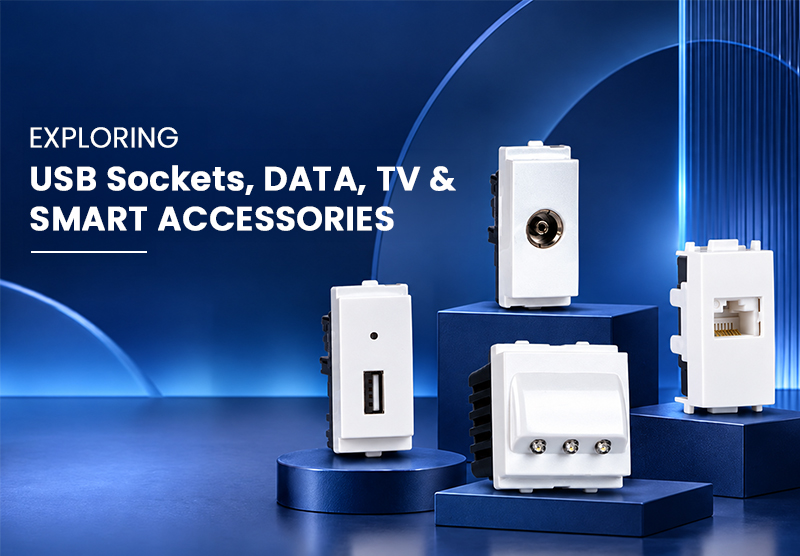
Modular systems are designed around specific plate sizes, module widths, and support accessories. So before purchasing, confirm that the socket is compatible with your chosen modular switch plate and frame. Here are a few practical checks to look out for:
- Does the socket module fit the plate size you have selected?
- Do you need a support plate or mounting accessory?
- Is the finish consistent across switches, sockets, and plates?
- Can you add more modules later if your requirements change?
These checks are especially useful in kitchens, study areas, and bedrooms, where you may want a combination of switches, sockets, USB chargers, or data points on the same wall.
MCB Types and Applications
An understanding of MCB types and applications will be instrumental in determining the most suitable miniature circuit breaker for a particular application.
Lighting circuits generally use 6 A to 10 A single-pole Type B or C circuit breakers. In residential applications, 16 A to 25 A Type B or C circuit breakers are generally used for power sockets. However, for air conditioning compressors, an MCB of Type C is used.
A Type C miniature circuit breaker is suitable for protecting circuits with high starting current and intermittent overloads. Type C breakers are usually applied for protecting circuits powering fluorescent lighting, small transformers, and motors.
How do you choose an MCB for an air conditioner? Firstly, the size or the continuous current rating of an air conditioner must be known. For example, a 16 A, 20 A, 25 A, or 32 A circuit breaker may be required, depending on the air conditioner’s tonnage and power.
It is also essential to ensure that the circuit breaker has a curve protection type that will not trip unnecessarily due to the high inrush current that the compressor will draw when it first starts. A Type C circuit breaker is sensitive to overloads but does not trip when there is no fault in the circuit. It is, therefore, ideal for protecting air conditioning compressors without being affected by normal high inrush currents.
Using the incorrect circuit breaker is very common, especially with MCBs designed for domestic use. Sometimes a circuit breaker is too sensitive for the load and trips off unnecessarily. Similarly, a circuit breaker with a higher rating than the circuit can sustain can cause serious damage to the circuit wiring. Therefore, it is critical to ensure that the correct circuit breaker size is selected.
Conclusion
xThe main issue with electrical circuits is to ensure that they are appropriately protected against short circuits and overloads. For some circuits, choosing the right circuit breaker can be confusing. The most important consideration in circuit protection is to ensure that the rating of the circuit breaker is appropriate.
For example, a 16 A circuit breaker would be ideal for protecting a small circuit with several general power outlets. On the other hand, a 32 A circuit breaker would be more appropriate for protecting power outlets in residences. For an air conditioner, a circuit breaker with a Type C curve is usually recommended. The C-type circuit breakers will not be affected by the high inrush current that the air conditioner’s compressor will draw when it starts.
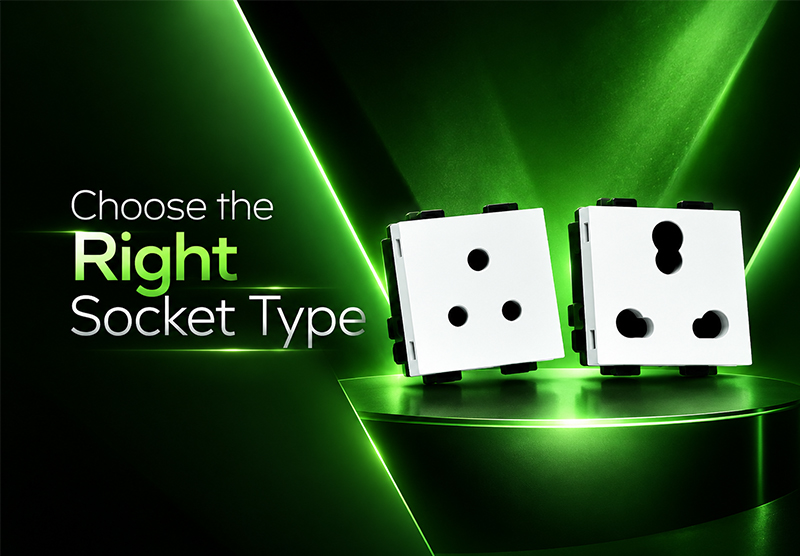
Precision Electricals offers a wide range of modular switches and circuit breakers, including the M5 Series Miniature Circuit Breakers and D5 Series Distribution Boards. We also offer a wide variety of modular socket outlets. If you want to know more about them, check out our guide to choosing the right modular socket outlet types.
FAQ
Use a circuit breaker for your home depending on the load and wire size. Lighting circuits – 6-10 A, power circuits 16-25 A. Never use higher-amperage circuit breakers than the wire size because it can cause the wiring to overheat.
Depending on the type of circuit breaker, the trip unit should be chosen. Type B: 3-5× the rating, mainly used for lighting, resistive heating, and other low starting current loads. Type C: 5-10× the rating, motors, transformers, and fluorescent lighting. Type D: 10-20× the rating, large motors. A circuit breaker with the wrong type or size will cause either nuisance tripping or will not provide sufficient protection for the circuit.
The circuit breaker is the overall name for the electrical device, while the miniature circuit breaker (MCB) is a specific type of circuit breaker. MCB circuit breakers are typically used for lower current applications ranging from 0.5 to 125 A at a lower voltage level. MCB circuit breakers are usually applied on the secondary side of a transformer and serve as the ultimate overcurrent protection for feeders and branch circuits. They should not be used as the main incomer for a low-voltage switchgear.
Single-pole circuit breakers are used for lighting and 230 V circuits; they have only one live pole. Double-pole circuit breakers (double circuit breakers) disconnect both the live and neutral conductors. They are used in single-phase distribution systems for large loads and to increase the degree of safety and isolation of the circuit during maintenance. In three-phase circuits, three-pole and four-pole miniature circuit breakers are used.
Air conditioning units usually require the use of type C circuit breakers (5-10 x In). This type of circuit breaker has a higher trip current and is not triggered by the inrush current from the compressor that starts up. The circuit breaker for the air conditioner should be selected based on the tonnage and power of the air conditioning unit and the current rating (16 A, 20 A, 25A, 32 A), accordingly.